
Singapore Is Now a Super-Aged Society: How to Prepare Your Home and Body for Ageing in Place

In September 2026, Singapore officially became a "super-aged" society. According to the latest Population in Brief report, 21.4% of citizens are now aged 65 and above, and around 152,000 are 80 or older. By 2035, more than one in four citizens is expected to be 65 or older.
Headlines like this can feel heavy. We see it differently. Most older Singaporeans tell us the same thing: they want to keep living in their own homes, doing their own marketing, taking the MRT on their own, and playing with their grandchildren without worrying about a fall. That is what ageing in place means, and it is very achievable with the right preparation.
Preparation comes in two parts. The home, and the body that lives in it.
Why "Ageing in Place" Is About More Than the Flat
Ageing in place simply means continuing to live safely and independently in your own home as you get older. It is often discussed as a housing question: grab bars, ramps, non-slip floors. Those matter. But in our experience, the home is only half the picture.
A grab bar helps you when you are already unsteady. Strength and balance help you stay steady in the first place. The two work best together.
Part One: Preparing Your Home
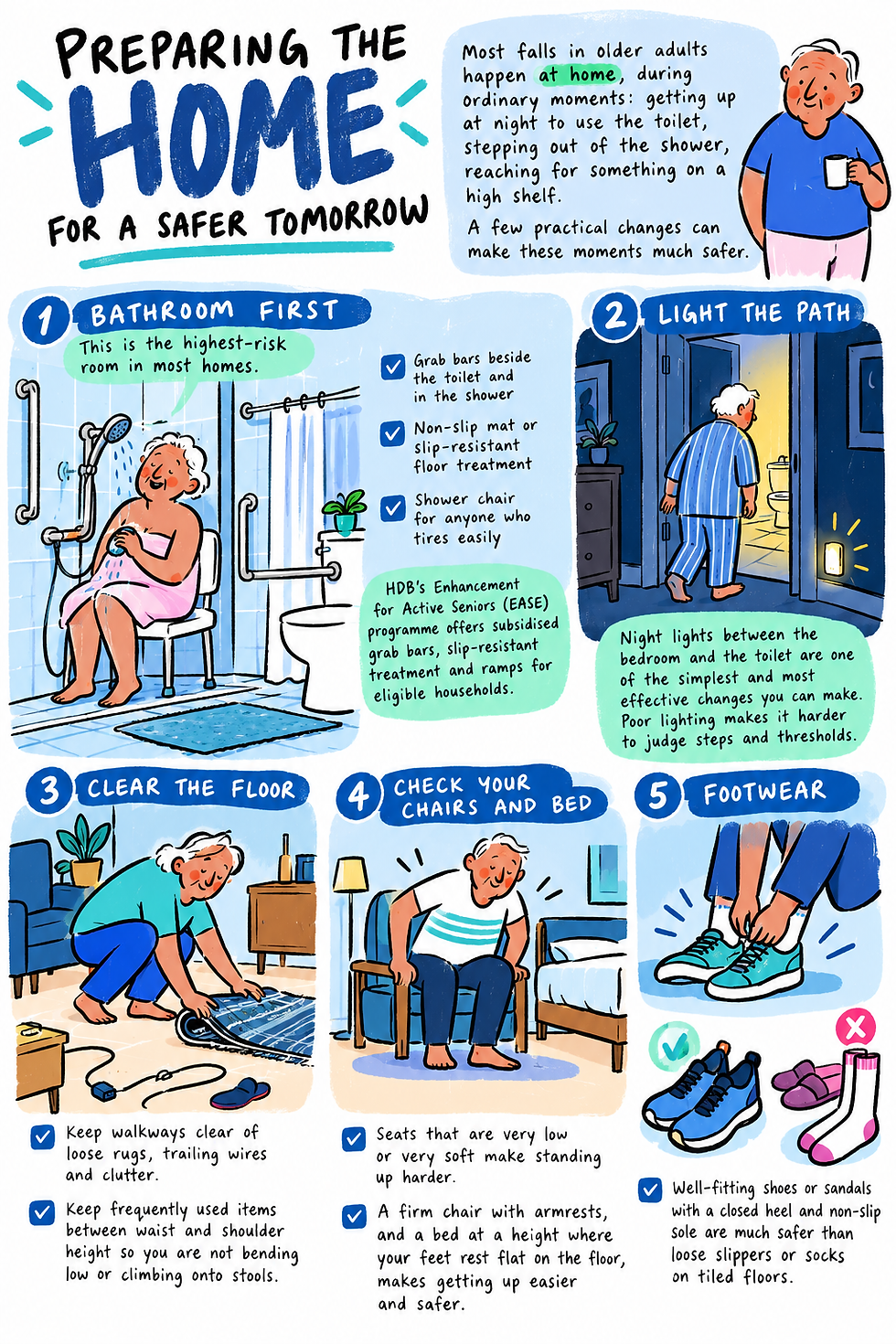
Most falls in older adults happen at home, during ordinary moments: getting up at night to use the toilet, stepping out of the shower, reaching for something on a high shelf. A few practical changes can make these moments much safer.
Bathroom first. This is the highest-risk room in most homes. Grab bars beside the toilet and in the shower, a non-slip mat or slip-resistant floor treatment, and a shower chair for anyone who tires easily can all reduce risk. HDB's Enhancement for Active Seniors (EASE) programme offers subsidised grab bars, slip-resistant treatment and ramps for eligible households, so it is worth checking whether you qualify.
Light the path. Night lights between the bedroom and the toilet are one of the simplest and most effective changes you can make. Poor lighting makes it harder to judge steps and thresholds.
Clear the floor. Loose rugs, trailing wires, and clutter in walkways are common tripping hazards. Keep frequently used items between waist and shoulder height so you are not bending low or climbing onto stools to reach them.
Check your chairs and bed. Seats that are very low or very soft make standing up harder. A firm chair with armrests, and a bed at a height where your feet rest flat on the floor, makes getting up easier and safer.
Footwear. Well-fitting shoes or sandals with a closed heel and non-slip sole are much safer than loose slippers or socks on tiled floors.
Part Two: Preparing Your Body
Home modifications reduce hazards. But the most powerful protection is a body that can handle everyday movement with confidence. Three physical qualities matter most.
1. Leg strength
Standing up from a chair, climbing stairs, stepping onto a bus. All of these depend on strong legs. Muscle mass and strength naturally decline with age, but research consistently shows that strength can be built at any age with the right training. It's never too late to start.
A simple self-check: can you stand up from a dining chair five times without using your hands, in under 15 seconds? If this feels difficult, it is a useful signal that your leg strength deserves attention.
2. Balance
Balance is a skill, and like any skill it can be trained. Practising standing on one leg near a stable surface, walking heel to toe, or turning steadily on the spot all help your body respond better when you trip or misstep.
3. Walking confidence
Many older adults begin to walk less after a near-fall, not because they cannot, but because they are worried. Less walking leads to weaker legs, which leads to more worry. Breaking that cycle with safe, guided movement is often the turning point for our clients.

What Safe, Guided Training Looks Like
We often meet older adults who want to exercise but feel unsure where to start. Gyms can feel intimidating. Online videos do not know your medical history. Some have heart conditions, joint replacements, or are recovering from a stroke.
This is where a physiotherapist-led approach makes the difference. Before any exercise begins, a physiotherapist assesses your strength, balance, walking, and medical history. Exercises are then chosen and adapted for you, and progressed gradually as you get stronger.
At Thrive Healthcare, this is exactly how our Legends Programme works. Legends is our physiotherapist-led group fitness class for older adults, running since 2019. Classes focus on strength, balance, endurance, and everyday movement, with every exercise scaled to each member. Just as importantly, members train alongside others at a similar stage of life. The friendships that form are part of what keeps people coming back week after week.
Many of our Legends members have shared how the training has given them greater confidence in their everyday movements, helping them feel more capable and independent in their daily lives.
For those who are not yet ready for a group class, or who are recovering from surgery, illness, or a fall, our physiotherapists also provide home physiotherapy island-wide. Sessions happen in your own space, so we can work on the exact stairs, chairs, and bathroom you use every day, and suggest home adjustments along the way. If you prefer to be in a dedicated space, we offer clinic/gym-based physiotherapy as well.
A Simple Checklist to Start This Week
Walk through your home at night and note any dark or cluttered paths
Check the bathroom for grab bars and non-slip surfaces
Look into HDB's EASE programme if you live in an HDB flat
Try the five-times sit-to-stand check
Talk to a physiotherapist if you have had a fall, feel unsteady, or are unsure how to start exercising safely
The Bottom Line
A super-aged Singapore does not have to mean a frailer Singapore. With a safer home and a stronger body, many older adults can continue living independently, and doing the things they love, for many years to come.
Strength is not just for athletes. It is what lets you stay independent. And it is never too late to build it.
If you or a parent would like guidance on staying strong and independent at home, Thrive Healthcare's physiotherapists can help. Try a Legends class, or book a home physiotherapy assessment at thrivehealthcare.com.sg or call +65 8949 8760.
Thrive Healthcare | 5 Mohamed Sultan Road, Singapore 239014 | 5 minutes from Fort Canning MRT
References
National Population and Talent Division, Prime Minister's Office. Population in Brief 2026 (released 25 September 2026).
HDB. Enhancement for Active Seniors (EASE). hdb.gov.sg


Comments