
Train Like You Want to Play at 60: A Physio’s Guide to Longevity in Sport

Updated: Jun 11
Learn how sports physiotherapy and injury prevention help you sustain sports training into your 60s, with expert strategies for older adults.
For many Singaporeans, sport is a part of your identity. Whether you are a weekend footballer, a recreational tennis player, or a masters swimmer, the desire to keep playing does not stop as you get older.
Many athletes worry age-related physical changes can challenge their goal to play well into later decades. However, aging does not mean retiring from sport. Master athletes in their 60s and beyond can continue playing and competing through deliberate strength and conditioning training, functional training, and proactive injury prevention.
In this guide, learn how proper training and sports physiotherapy can help you sustain your performance as you get older.
How Our Bodies Decline with Age And How This Affects Athletes
As humans age, we experience a reduction in physical and cognitive functions, affecting strength, mobility, balance, and mental processing.
Muscle mass and strength naturally decrease after the age of 30, accelerating in older adults due to sarcopenia (muscle loss). Balance and flexibility decline from reduced proprioception and joint mobility, increasing risk of falls - a leading cause of injury for seniors.
Processing speed, attention, and memory also slow with age due to brain changes like white matter loss and synaptic plasticity decline (the reduction of connections between brain neurons). Your VO2max (how much oxygen your body can use per kilogram of body weight) also tends to decline by about 10% per decade after the age of 25.
Every athlete eventually encounters changes in sports training due to age-related decline. Research on senior athletes shows that performance declined approximately 3.4% per year over 35 years of competition, slowly from ages 50 to 75 and dramatically after the age of 75.
Older athletes also experience longer recovery. A young athlete may take approximately 2-3 weeks to fully adapt to a training stress, while a 55-year-old may require up to 1-2 months to adapt to the same conditions.
Without proactive intervention, master athletes face significantly higher risks of sport injuries and long-term health issues. However, consistent and well-structured sports training now can help slow age-related decline and keep you playing sports well later in life.
How Proper Training Builds Long-Term Resilience in Sport
Strength and conditioning training is one of the most effective interventions for preserving athletic capacity over time. Research shows that strength training can reduce sports injuries to less than one-third of baseline rates, and overuse injuries could be almost halved. The mechanism is straightforward: a body that is consistently and progressively challenged builds the muscular, tendon, and ligament strength needed to handle the loads of sport.
Functional training adds another layer of protection. Unlike isolated gym exercises, functional training targets the movement patterns that sport demands: rotational power, single-leg stability, deceleration, and reactive agility. These are the qualities that help an athlete change direction safely, absorb impact, and maintain control when tired. Training these patterns specifically is a form of injury prevention in itself.
Performance enhancement exercises like plyometrics, loaded carries, and sport-specific movement drills are also appropriate for athletes of all ages when properly programmed.
Training Assessment
Every athlete on this journey should start with a thorough evaluation of medical history, balance, gait, strength, and mobility risks. At Thrive Healthcare, physiotherapists use tests like the chair-rise or gait speed to establish baseline function and identify risks, ensuring safe progression for our clients. This guides personalised exercise plans, adapting for age-related changes.
Core Training Principles
Follow evidence-based methods prioritising specificity, progressive loading, and recovery:
Train movements matching your sport, such as squats for power transfer in tennis or running.
Use bodyweight, bands, machines, or household items for resistance; progress volume (reps), intensity (load), or complexity weekly by 5-10% when form holds.
Aim for 2-4 training sessions per week
Focus on compound, unilateral moves for efficiency and injury prevention:
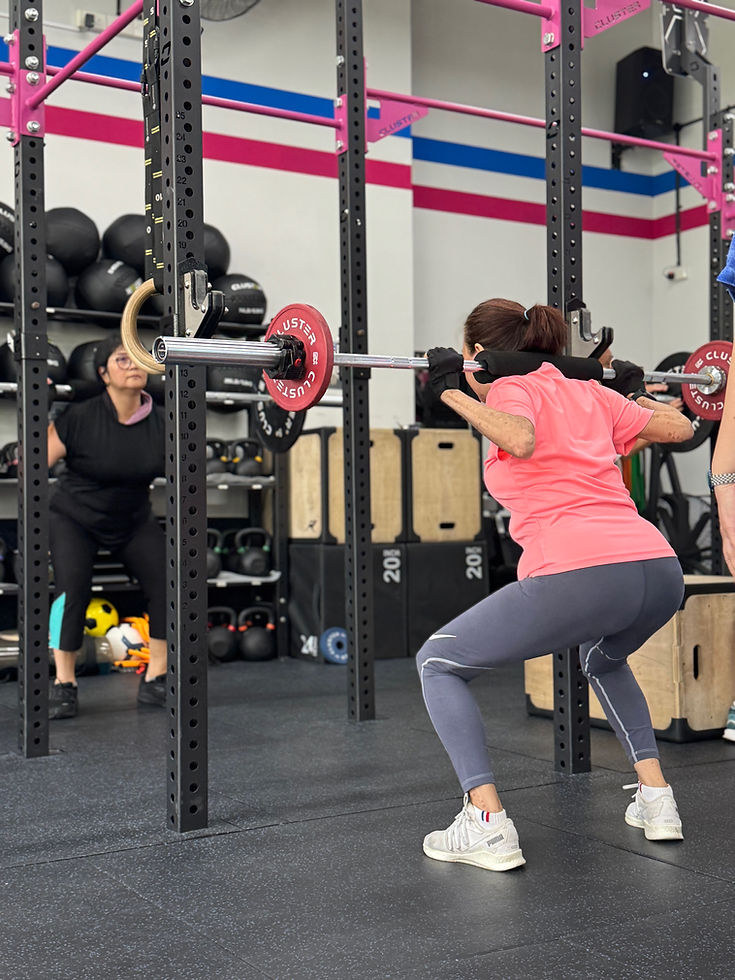
Progressive squats: Builds lower limb power and mobility.
Glute bridges: Stabilises the hips for running and rotational sports like golf; prevents knee collapse under load.
Single-leg deadlifts: Enhances single-leg strength and balance
Calf raises/Step-ups: Improves push-off power for acceleration and jumping; reduces Achilles tendon injury risk.
Bulgarian split squats: Corrects left-right muscle imbalances; builds unilateral leg strength.
Single-arm rows: Improves posture and enhances pulling power; supports scapular and shoulder stability.
Wall push-ups: Strengthens the upper body and chest; supports daily pushing tasks and sport movements.
Lateral lunges: Enhances side-to-side stability for court and field sports; prevents hip and groin issues.
Planks: Strengthens core; improves spinal support.
Scapula wall slides: Increases shoulder flexibility and aids scapular stability, especially for racket, throwing, and swimming sports.
The key is progressive loading rather than jumping to heavy weights or high volume too quickly.
Training Mistakes That Speed Up the Age-Related Decline
Even experienced recreational athletes make errors that add to the effects of ageing, rather than countering them. These are the patterns we see most often as physiotherapists, and the ones that most commonly lead to a sports injury:
Skipping strength work in favour of cardio only. Many older adults gravitate toward running, cycling, or swimming because it feels familiar and manageable. But without strength and conditioning training, muscle loss goes unchecked. Cardiovascular fitness does not protect joints, and it does not prevent the muscular imbalances that cause overuse injuries. Both are necessary.
Ignoring recovery as part of the training plan. At 25, you could train hard three days in a row and feel fine. At 50, that same block might leave you injured or burnt out. Recovery should be an active part of the process, and it must be deliberately programmed. Older athletes who train too hard, too long, or too often without adequate recovery are most likely to find themselves sidelined.
Treating pain as normal. "It is just part of getting older" is one of the most common things we hear from master athletes presenting with persistent discomfort. Pain during or after training is a signal, not a background condition to be tolerated. If left unaddressed, it leads to compensatory movement patterns, which increase the risk of a secondary injury elsewhere in the body.
Training the same way they did years ago. The training volume and intensity that worked at 25 is not appropriate at 45. Older athletes need more recovery between sessions, more focus on movement quality, and more attention to injury prevention work. Continuing to apply a younger training model to an older body is one of the easiest ways to get hurt.
Neglecting mobility alongside functional training. Flexibility, joint range of motion, and movement quality are the foundation everything else is built on. Without them, performance enhancement exercises and sport-specific drills carry far more risk than they should.
Resting completely after injury. Extended inactivity following a sports injury adds to what it is meant to protect against. Evidence-based rehabilitation using progressive loading is what restores sport readiness most effectively.
How Sports Physiotherapy with Thrive Healthcare Can Help You Keep Playing for Years to Come
Understanding the physiology of ageing is valuable. Sports physiotherapy helps you apply that knowledge consistently, safely, and in a way that fits your specific body and sport.
At Thrive Healthcare, our physiotherapists work with many active older adults and master athletes who want to stay in the game. We start with a thorough assessment of how you move, what your sport demands, and what your body's vulnerabilities are. From there, treatment and training are built around the goal of keeping you playing for as long as you choose.
Injury Assessment and Rehabilitation
When a sports injury occurs, the speed and quality of your recovery matters. Thrive Healthcare's rehabilitation programme for active adults targets strains, sprains, and joint injuries with exercises and manual therapy to address the underlying causes.
Movement Screening and Injury Prevention
Our physiotherapists identify the movement deficiencies, muscular imbalances, and load management errors that put adults at risk of injury before anything goes wrong. Injury prevention through proactive screening is more effective and far less disruptive than treatment after the fact.
Strength and Conditioning for the Master Athlete
Thrive Healthcare's Legends Programme is a physiotherapist-led strength and conditioning training programme built specifically for older adults. It was recognised as a finalist at the Asia Pacific Eldercare Innovation Award for its genuine effectiveness at building the physical resilience older adults need to stay active and injury-free.
Functional Training and Performance Enhancement
Whether your goal is returning to recreational sport, improving your game, or simply keeping pace with the physical demands of an active lifestyle, our functional training and performance enhancement exercises are designed around your movement patterns, your sport, and your body's specific needs.
Ready to Prepare Your Body for Longevity in Sports?
One of the most common things we hear from master athletes who come to Thrive Healthcare is some version of the same sentence: "I just assumed this was normal for my age." Most of the time, it doesn’t have to be.
A body that is trained well - with proper strength and conditioning training, consistent injury prevention work, and appropriate functional training - can help you hold up sport activities for years and years.
If you are an athlete who wants to keep playing, or who has been sidelined by a sports injury and is not sure where to start, our team is ready to help.
Book a consultation with Thrive Healthcare today and take the first step toward playing the sport you love for as long as you choose.


Comments