
How Physiotherapists in Singapore Help With Mobility Aids

Updated: Feb 2
Mobility aid fitting, gait training, & caregiver support in Singapore. Expert physiotherapy for walking sticks, walkers, wheelchairs, & independence.
Imagine regaining the confidence to walk safely, travel outdoors, or navigate your own home independently after injury, illness, or problems with aging. Meaningful improvements in mobility often come from the interplay of various supports, including expert guidance from a physiotherapist, and the careful choice of a suitable mobility aid.
For many Singaporeans facing mobility challenges, mobility aid fitting and training can be the difference between staying independent and relying unnecessarily on others. Yet, most people receive little guidance about selecting, fitting, or using mobility aids effectively.

At Thrive Healthcare, our physiotherapists recognize that mobility aids are far more than metal frames; they're tools for optimizing independence that require proper fitting, skillful training, and ongoing support to fully utilize. Physiotherapist assessments are needed to determine which mobility device suits your needs the best. With good understanding of its indications, precautions, and contraindications, they can guide you on how to use it safely and effectively.
Why Professional Mobility Aid Fitting Matters
The right mobility aid must match your specific physical capabilities, health condition, and environmental needs. An ill-fitting mobility aid doesn't just fail to help; it can negatively impact or contribute to new problems while attempting to solve the original issue. For example, a walking stick at the wrong height leads to improper gait patterns that create problems upward through your body.
Identifying a suitable mobility device doesn't just look at your physical needs, but also whether it is realistic for you to utilize in your environment. For instance, a walking frame may help you balance better when you walk, but if the corridor or toilet space is limited, it no longer serves its purpose well, and may even result in increased falls risk as you cannot utilize it properly. These seemingly small technical errors add up over time, turning aids designed to improve mobility into sources of frustration and additional injury.

When you work to restore or maximize your mobility, physiotherapists help ensure devices serve your actual needs, rather than creating more difficulties. A properly fitted mobility aid, selected and adjusted by a qualified physiotherapist, can:
Reduce the risk of secondary injuries, overuse pain, and falls
Improve posture, balance, and weight distribution, which lowers fatigue and joint strain
Boost long-term adherence and satisfaction, as users are far more likely to use mobility aids that are comfortable and tailored to their needs
Optimize functional outcomes, with improvements in walking speed, stride length, and overall mobility, especially when paired with ongoing physiotherapy and gait training
Enhance psychological well-being, giving a sense of freedom and confidence
Empower caregivers, who receive training in safe mobility assistance and daily activity support, reducing injury risk for both user and helper
Did you know? In Singapore, falls make up 40% of injury-related deaths, while one in three adults aged 60 and above have fallen more than once. Proper mobility aid fitting and training by qualified physiotherapists can significantly reduce this risk by ensuring devices provide appropriate support while promoting safe movement patterns.
At Thrive Healthcare, our physiotherapists conduct comprehensive assessments considering your height, weight, strength, balance, cognitive function, home environment, and specific medical conditions before recommending any mobility device.
Fitting and Training for Different Mobility Aids

Different mobility aids serve distinct purposes, and require specialized fitting and training to maximize safety. Understanding what each device offers helps you work with your physiotherapist to select appropriate equipment.
Walking Sticks and Canes

Walking sticks may suit individuals with mild balance impairments or single-leg weakness who can bear most of their weight independently. They provide additional stability while maintaining relatively normal walking patterns.
Your physiotherapist determines the correct stick height by having you stand upright with arms at your sides. The cane handle should align with your wrist crease, creating approximately 15-20 degrees of elbow flexion when holding the device. This positioning ensures proper weight distribution without forcing awkward posture. Essential training includes correct hand placement, safe walking sequence, and navigation of stairs, steps, and kerbs.
Some walking sticks are also favoured because they are portable and lightweight. Some are even collapsible and easy to bring from one place to another (e.g. for holidays). Walking sticks with light features may be suitable for people who need extra visibility when walking at night indoors.
While most walking sticks must be propped against a wall or laid flat when not in use, newer designs feature wider base tips that allow them to stand upright on their own, offering significant convenience in situations like trips to the bathroom.
Walkers and Walking Frames

Walkers are typically used to describe mobility walkers that have a frame with legs or wheels; they can help to provide stability for individuals with significant balance impairments, bilateral leg weakness, or those recovering from major surgery. They offer four-point contact with the ground, creating a stable base of support.
Ideal walker height positions the handles at wrist level when arms hang naturally, allowing 15-20 degrees of elbow flexion during use. Your physiotherapist ensures adequate space for normal stride length, while verifying you can comfortably stand upright rather than hunching forward. Physiotherapists teach you the correct four-point walker sequence:
Pick up walker: Using shoulder depression and elbow extension
Walking sequence to optimize balance, support weightbearing, and eventually work towards normalizing gait pattern
Weight bearing: Lean appropriately on frame while maintaining upright posture
Step into walker: Place feet within the frame perimeter for maximum stability
Repeat cycle: Develop smooth, coordinated rhythm
For wheeled walkers (rollators), additional instructions include brake application, turning, and sitting on the integrated seat safely. These devices require different handling than standard walkers; their continuous contact with the ground enables more natural gait patterns, but demands good cognitive function and upper body control. There are 2 types of wheeled walkers: 2-wheeled walkers (rollator frames) and 4-wheeled walkers. Since using walkers requires both hands, newer designs often include attached baskets, which can be helpful for carrying items around the house.
Quad Sticks
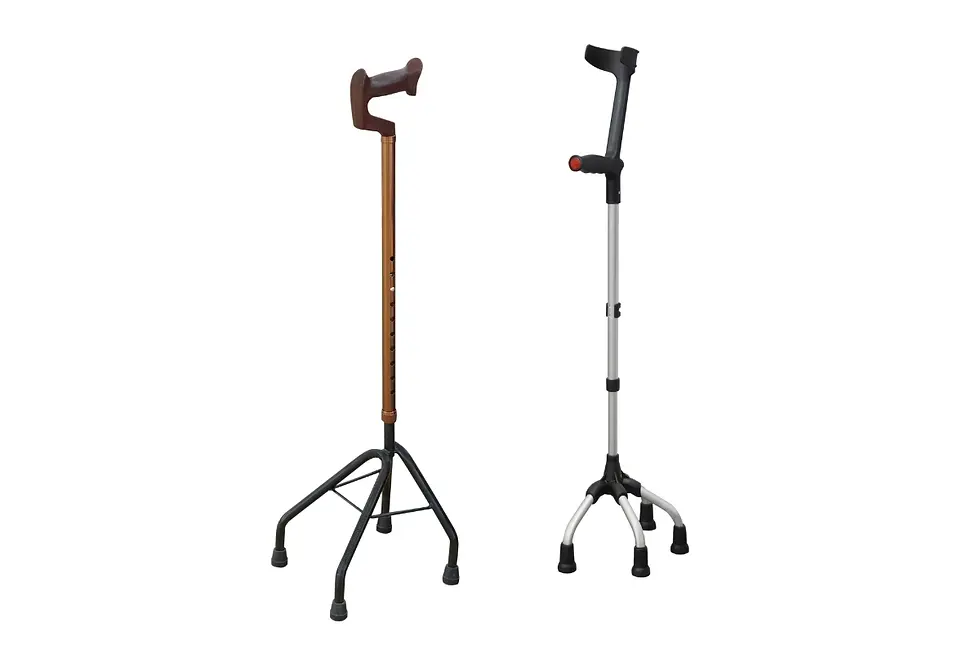
Quad sticks provide greater stability than standard canes while maintaining the single-hand convenience of canes. They suit individuals with moderate balance impairments or mild-to-moderate weakness on one side. Quad sticks are particularly valuable during recovery transitions when moving from walkers toward independent cane use.
Like standard canes, your physiotherapist ensures the handle aligns with your wrist crease when arms hang naturally. Your physiotherapist also verifies that the four-point base contacts the ground evenly when the device is positioned upright, without tilting or rocking. Essential training include:
Stable base positioning: The four-point contact improves stability over three-point cane designs, but requires proper ground contact
Hand placement and grip: Holding the handle securely while allowing natural arm swing on the non-affected side
Loading technique: Properly distributing weight through the device without excessive pressure on the base points
Turning and maneuvering: Using subtle body and arm movements to redirect the quad stick base during turns or obstacle navigation
Limitations recognition: Four-point bases may catch on uneven ground or obstacles, requiring careful attention in challenging environments
Crutches
Crutches suit individuals requiring significant upper body support when lower extremity weight-bearing must be minimized or eliminated. Common situations include acute fractures with non-weight-bearing restrictions, post-surgical recovery when bearing weight compromises healing, or severe acute pain from ligament injuries. Crutches enable mobility without loading the injured lower extremity, critical during early recovery phases.
Axillary Crutches

Axillary crutches suit individuals with good upper body strength and coordination, though they require careful fit to avoid nerve compression in the axillary (underarm) region.
Your physiotherapist measures with you standing upright and arms at your sides, positioning the crutch tops approximately 2.5 - 4 centimeters below the armpit. The handle should align with your wrist crease, allowing 15-20 degrees of elbow flexion. This positioning prevents excessive underarm pressure that can cause "crutch palsy", a temporary nerve compression affecting shoulder and arm function.
Elbow Crutches (Forearm Crutches)

These crutches feature a cuff encircling the forearm with handles positioned lower, distributing weight across the forearm rather than concentrating pressure in the armpit. Elbow crutches suit individuals with shoulder pain, weakness, or those at risk for nerve compression, as well as those requiring extended crutch use.
Similarly to axillary crutches, your physiotherapist measures elbow crutch height so that when standing with arms at your sides, the handle positions at your wrist crease allowing 15-20 degrees of elbow flexion. The forearm cuff should fit snugly but comfortably, typically positioned 2.5 - 4 centimeters below the elbow. Proper cuff positioning prevents circulatory compression while maintaining secure device contact.
Training for crutches differs fundamentally from cane or walker training because crutches involve coordinated upper and lower body movement, requiring practice and proper technique to prevent injury:
Non-weight-bearing and partial weight-bearing gaits: Two-point and three-point gait patterns based on healing stage
Underarm and hand positioning: Avoiding excessive pressure that causes nerve or wrist injury
Navigation of stairs, steps, and kerbs
Shoulder and core stability: Using large muscle groups safely without isolated arm strain
Balance and weight distribution: Coordinating upper and lower body for stability and lower fall risk
Transition techniques: Moving safely between surfaces, thresholds, and kerbs
Progressive loading: Gradually increasing weight through injured leg as healing allows
Wheelchairs and Pushchairs

Wheelchairs become necessary when walking costs you excessive physical energy, creates safety concerns, or when extended mobility is required beyond current capacity. Wheelchairs are designed such that the user is able to propel themselves independently, while a pushchair requires another person to assist in propelling the user in the pushchair.
Wheelchair fitting is the most complex mobility aid fitting and training service, requiring detailed assessment and customization. Your physiotherapist evaluates multiple dimensions to ensure proper sizing and postural support:
Seat width and depth: Slightly wider than the hips and slightly shorter than the thighs to reduce pressure while maintaining good posture
Seat height: Allows feet to rest flat on footrests or floor for easier transfers
Back and armrest height: Enables comfortable positioning without shoulder elevation
Footrest adjustment: Ensure adequate support for the user
Your physiotherapist will give you wheelchair training, including:
Propulsion techniques: Efficient hand positioning and pushing patterns for manual wheelchairs
Transfer: Safe methods for moving between wheelchair and bed, toilet, car, etc.
Obstacle navigation: Kerbs, thresholds, tight spaces, and uneven surfaces
Maintenance: Daily safety checks like tire pressure and brake function monitoring
Pressure relief: Regular weight shifts to prevent pressure injuries during prolonged sitting
Teaching Safe Usage to Patients and Caregivers
Effective mobility aid fitting and training extends beyond the device user to include family members and caregivers who provide daily support.

Caregivers require specialized skills to assist safely and effectively without causing injury to themselves or their loved ones. At Thrive Healthcare, our caregiver physiotherapy support training programs address essential techniques for safe assistance and transfer:
Proper positioning: Standing at appropriate angles during transfers and walking assistance
Synchronized movement: Extending legs on the same side simultaneously to prevent collisions and maintain rhythm
Appropriate contact points: Where and how to hold without restricting movement or causing discomfort to the patient
Transfers between surfaces: bed-to-chair, chair-to-toilet, and car transfers using proper body mechanics, leverage points, and transfer boards or other assistive equipment.
Caregivers also learn device management: adjust heights, apply brakes properly, fold and transport equipment, recognize maintenance needs, and troubleshoot common problems preventing device abandonment or improper use.
Our physiotherapists will guide caregivers in identifying and modifying home hazards, including removing tripping hazards, improving lighting, installing grab bars in bathrooms, and arranging furniture to accommodate mobility device usage.
Caregiver training also includes identifying warning signs like skin breakdown from pressure or friction, increased pain or swelling, changes in gait patterns, and when to contact healthcare providers versus managing issues independently.
Journey to Independence

For some individuals, the ultimate goal of mobility aid fitting and training isn’t long-term reliance on the device; it’s using the aid while building strength, balance, and confidence to gradually achieve greater independence. This journey requires careful progression guided by physiotherapy expertise.
Physiotherapists at Thrive Healthcare use standardized outcome measures to objectively track progress and determine readiness for different rehabilitation stages. Some functional assessments are:
10 meter walk test: Measures walking speed with and without device
Timed up and go: Assesses mobility, balance, and fall risk
Single leg stance: Evaluates balance capacity
Knee extension strength: The key determinant for mobility aid need
While each person’s rehabilitation journey is different, our physiotherapists work with you to follow a 4-stage process to reach your max potential independence.
Stage 1: Maximum Support
Immediately post-surgery or during acute recovery, mobility aids provide essential support while protecting healing tissues. Focus includes learning proper device usage, building confidence with assistance, and preventing complications through early mobilization.
Stage 2: Active Rehabilitation
As strength improves, gait training emphasizes proper walking patterns while gradually reducing device dependence. Physiotherapists introduce strengthening exercises targeting knee extensors, hip stabilizers, and ankle control - muscles essential for independent mobility.
Stage 3: Transitional Independence
Patients practice walking without devices in controlled environments, progressing to less restrictive aids (walker to cane, cane to nothing), and building endurance for community distances. Balance training and fall prevention exercises become priorities.
Stage 4: Functional Independence
Complete or near-complete independence in daily activities with appropriate challenge exercises maintaining gains. Some individuals require permanent mobility aids for specific situations (long distances, uneven terrain, fatigue management) while functioning independently otherwise.
While mobility aids provide immediate support, therapeutic exercises will be used to address underlying impairments and reduce long-term device dependence. Your physiotherapist designs personalized exercise programs targeting specific deficits, including strength training, balance and proprioception training, and functional movements.
The Thrive Healthcare Approach to Mobility Aid Support
At Thrive Healthcare, we understand that mobility represents more than physical movement; it determines your ability to participate in activities you love, maintain social connections, and preserve your independence and quality of life. Our comprehensive mobility aid fitting and training services integrate with broader rehabilitation programs, ensuring every aspect of your recovery receives expert attention.
We begin with thorough evaluation of your physical capabilities, medical history, home environment, support systems, and personal goals. This assessment ensures recommendations match your complete situation, rather than addressing mobility in isolation.
For device selection, we consider your specific needs including body dimensions, strength and balance capacity, cognitive function, environmental demands, and personal preferences.
Our physiotherapists provide detailed instruction and supervised practice until you demonstrate safe and confident device usage. Family members and caregivers also participate in training sessions to learn proper assistance techniques, safety precautions, exercise supervision, and when to contact us with concerns.
Home-based mobility aid fitting and training allows assessment and adjustment in your actual living environment, helping you use devices safely and effectively. This approach is particularly beneficial for post-surgical patients, seniors, and anyone facing transportation challenges.
Ready to enhance your mobility and independence through expert guidance? Contact Thrive Healthcare today to schedule your comprehensive mobility aid fitting and training assessment.


Comments