
Tennis Elbow vs Golfer’s Elbow: A Physiotherapist Explains the Difference
- Thrive Healthcare

- Feb 2
- 6 min read
Learn about tennis elbow, golfer's elbow, and how physiotherapy helps you prevent and recover from elbow pain.
If you play tennis or golf, you might have heard and been wary of these phrases: tennis elbow and golfer's elbow. If you don’t play these sports, you may think there’s no need to worry. However, the surprising truth is you don't need to play tennis or golf to develop either condition.
Despite the very specific sport names, these conditions refer to injuries caused by repetitive strain on the elbow tendons from certain actions. Research shows that tennis elbow affects approximately 1-3% of adults annually worldwide, making it a remarkably common condition. Golfer’s elbow is less common; less than 1% of the population is affected, but the condition mainly attacks people between the ages of 40 and 60.
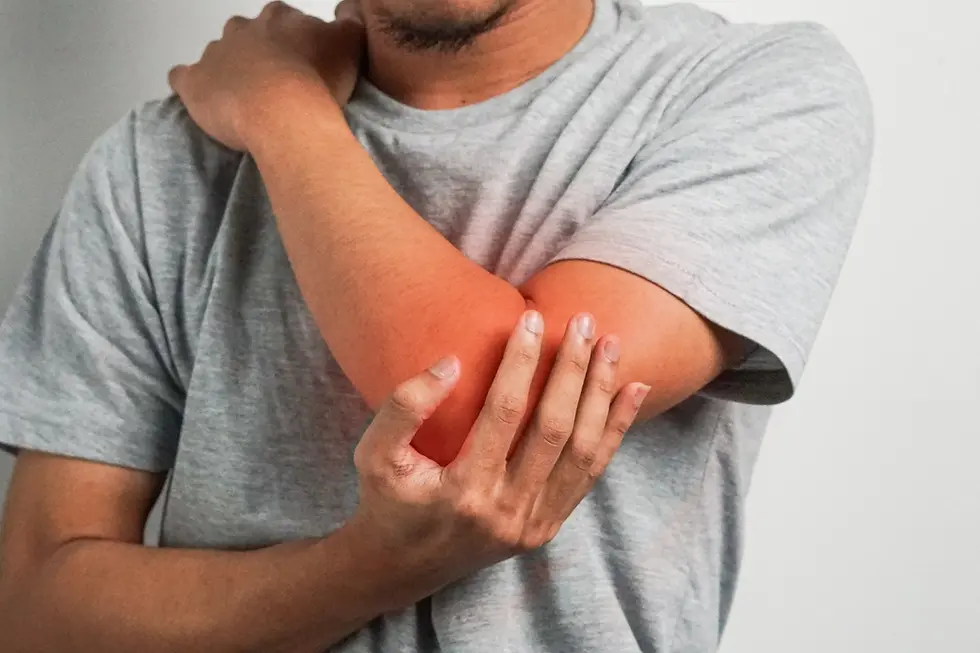
Understanding the differences between tennis elbow and golfer's elbow is important for proper diagnosis, treatment, and effective prevention. This guide will help you identify which condition you might have, understand what causes it, and discover how physiotherapy can help you recover and prevent recurrence.
What Is Tennis Elbow? - The Overuse Injury of the Outer Elbow
Tennis elbow, medically known as lateral epicondylitis, is an overuse injury affecting the tendons on the outer (lateral) side of your elbow. The condition involves the extensor carpi radialis brevis (ECRB), a forearm muscle responsible for extending your wrist and stabilising your elbow.

How Tennis Elbow Develops
Tennis elbow develops through repetitive overuse injury patterns, rather than a single traumatic incident. The ECRB muscle, which helps stabilise your wrist when your elbow is straight, becomes damaged from overuse. Overuse causes microscopic tears in the tendon where it attaches to the lateral epicondyle - the bony bump on the outside of your elbow.
Unlike a sudden sprain that appears instantly, tennis elbow develops slowly over weeks or months of repetitive stress. Each repetition places small amounts of stress on the tendon. When that stress exceeds the tendon's capacity to heal and adapt, degenerative changes occur, pain increases, and function deteriorates. Research shows that office workers, nurses, and manual laborers comprise a significant portion of those affected - higher than active tennis players themselves.
Tennis Elbow Symptoms
Elbow pain from this condition presents on the outer elbow and forearm:
Pain or burning directly over the lateral epicondyle (outer elbow bump)
Pain that may radiate down the forearm toward the wrist
Weakness in grip strength
Difficulty with gripping tasks, like opening jars, holding utensils, turning doorknobs
Pain that worsens with wrist extension activities
Sometimes, discomfort at night
The pain typically begins mild and gradually worsens over time; many people report they can't pinpoint exactly when the symptoms started.
What is Golfer's Elbow? - The Overuse Injury of the Inner Elbow
Golfer's elbow, medically known as medial epicondylitis, is the "opposite" of tennis elbow. This overuse injury affects the tendons on the inner (medial) side of the elbow, involving the flexor carpi radialis (FCR) and other wrist flexor muscles responsible for gripping and wrist flexion.

How Golfer's Elbow Develops
Like tennis elbow, golfer's elbow results from repetitive strain causing microscopic tears in the flexor tendons where they attach to the medial epicondyle - the bony bump on the inside of your elbow. The condition develops gradually through cumulative stress from repetitive gripping, twisting, or wrist-flexion movements.
The pathology is similar to tennis elbow; the mechanism is different. Where tennis elbow results from wrist extension stress, golfer's elbow stems from wrist flexion and gripping stress.
Golfer's Elbow Symptoms
Elbow pain from golfer's elbow presents distinctly on the inner elbow and forearm:
Pain or tenderness directly over the medial epicondyle (inner elbow bump)
Pain that may radiate down the forearm toward the wrist
Weakness in grip strength and gripping capability
Difficulty with gripping, twisting, or flexing movements
Pain that worsens with wrist flexion or gripping activities
Sometimes, stiffness or reduced range of motion in the elbow
Golfer's elbow also typically develops gradually, with increasing pain and functional limitations over time.
Summary Table: Tennis Elbow vs Golfer's Elbow
Characteristic | Tennis Elbow (Lateral Epicondylitis) | Golfer's Elbow (Medial Epicondylitis) |
Location of Pain | Outer elbow and outer forearm | Inner elbow and inner forearm |
Affected Tendons | Extensor carpi radialis brevis (ECRB) and other wrist extensors | Flexor carpi radialis (FCR) and other wrist flexors |
Bone Attachment Point | Lateral epicondyle | Medial epicondyle |
Main Movement Triggering Symptoms | Wrist extension (going towards the back of the hand) | Wrist flexion and gripping (going towards the palm) |
Associated Activities Triggering Symptoms | Tennis backhands, turning doorknobs, painting, typing, using hand tools | Golf swings, gripping, twisting, using hand tools |
Both |
| |
Why You May Develop These Overuse Injury Conditions (Whether You Play Sports or Not)
Remember, you don't need to be a tennis player or golfer to develop these conditions. Both are overuse injuries resulting from two primary factors: excessive repetition and improper movement patterns.
As mentioned above, overuse injury develops when tissues are stressed repeatedly without adequate rest and recovery. Actions do not have to be intense for symptoms to develop. For example, office workers’ typing may place relatively low force on tendons each time they use the computer, but repetitive stress - 7 to 8 hours a day, 5 to 6 days a week, over months and years - can create cumulative damage.
Progressive overload is also critical. If you dramatically increase activity - starting a new sport, changing exercise routines, or taking on different work - without gradual adaptation, you may exceed your tendon's capacity and trigger symptoms.
Other factors including age, strength, and individual conditions also affect your risk or severity of tennis elbow or golfer’s elbow:
Weakness in forearm, wrist, and shoulder muscles forces the small tendon attachments to work harder.
Inflexibility in forearm, wrist, and shoulder muscles reduces your ability to distribute force effectively, concentrating stress on specific tendons.
Tendons become less resilient with age, recovering more slowly from stress.
History of elbow, wrist, or shoulder injury increases risk of recurrence.
How Physiotherapy Helps Elbow Pain Recovery and Prevention
Treating and preventing tennis elbow and golfer's elbow effectively requires professional guidance. This is where physiotherapy, sports injury rehabilitation, and home exercise programs at Thrive Healthcare can support you.
Comprehensive Assessment and Diagnosis
Beginning with a thorough assessment, our physiotherapists evaluate:
Movement Analysis: Observing how you move during activities that trigger symptoms - gripping, wrist movements, and sport-specific motions.
Strength Testing: Measuring strength deficits in forearm, wrist, elbow, and shoulder muscles. Impairments often appear on the affected side.
Flexibility and Range of Motion: Assessing tissue restrictions that might contribute to compensatory movement patterns.
Load and Activity History: Understanding what activities trigger symptoms and how training volume has changed.
Biomechanical Assessment: For athletes, analysing sport-specific techniques to identify movement patterns contributing to injury.
This assessment distinguishes your specific condition, identifies contributing factors, and helps to create a personalised treatment plan.
Treatment Methods for Overuse Injuries
Physiotherapy employs multiple evidence-based techniques. Pain management and load reduction strategies may include ice application, activity modification to minimise stress on the affected tendons, and the use of taping to decrease tendon load during the healing process.
In addition, manual therapy techniques - such as soft-tissue massage and joint mobilisation - can address muscle tightness and improve the mechanics of elbows and wrists.
More importantly, prevention and rehabilitation requires progressive strengthening and resistance training:
Pain-free strengthening: isometric exercises; gentle wrist flexion/extension exercises with minimal resistance; progression to eccentric training (controlled lengthening under load)
Resistance training using dumbbells, resistance bands, or household items
Progressive loading with careful monitoring of pain response
Sport or activity-specific strengthening replicating movement patterns
At Thrive Healthcare, we also design home exercise programs during treatment between sessions. Your home exercise programs for tennis elbow and golfer’s elbow can include:
Wrist and forearm stretching and mobility work
Progressive resistance training for forearm, wrist, and shoulder muscles
Kinetic chain strengthening addressing upstream dysfunction
Sport-specific movement practice
Ready to Protect And Strengthen Your Muscles?
Whether you're dealing with tennis elbow, golfer's elbow, another sport injury, or seeking ways to avoid them, specialised physiotherapy and rehabilitation can guide you.
Contact Thrive Healthcare today for a comprehensive physiotherapy assessment. Let our team help you understand your elbow pain and design your personalised prevention and recovery plan.


Comments